

The lowest-cost plan can leave the most decisions in your hands. An online workout program for men gives you a structured training schedule to follow at home or in a gym, with beginners able to start with 2-4 workouts per week. Programs may be self-guided or include coaching, depending on the level of support.
It makes sense to weigh cost against clarity: before you commit, you want to know what a plan includes, what equipment it requires, and whether it suits your goal. This guide explains how an online workout program for men works, how to choose a structure for muscle growth or general fitness, and what to consider when comparing costs and free trials.
You’ll also find practical advice on home workout equipment, from bodyweight basics to dumbbells and resistance bands. The goal is to choose a setup that fits your schedule, your space, and the effort you can sustain.
Key Takeaways
- Choose a training schedule you can sustain, then follow its structure long enough to assess your progress.
- Match home equipment to the exercises in your plan; a focused setup can be more useful than buying a full gym’s worth of gear.
- Let your main goal and available training days guide your choice of program, rather than selecting a routine by name alone.
- Compare what a program includes and how its trial works before weighing its cost against the level of structure and support you need.
How Do Online Workout Programs Work?
An online workout program for men organizes exercises into a repeatable plan, often with demonstrations, sets, repetitions, and rest periods. Beginners can start with 2-4 workouts per week, using full-body sessions or an upper/lower split. A clear schedule shows what to train and when to progress, without leaving each session to guesswork.
Beginner-friendly instruction breaks movements into practical steps: set your stance, brace your trunk, control the motion, and complete each repetition. Video demonstrations can show exercises from different angles. Use a workout log to record exercises and loads, an interval timer to manage rest, and an exercise library to revisit form cues between sessions.
- Low-impact options: Marching in place, chair squats, incline push-ups, and resistance-band rows offer controlled ways to practise movement patterns.
- Beginner routines: Start with simple movements and manageable resistance. For compound exercises, finish each set feeling you could perform 1-3 more repetitions.
- Advanced routines: More experienced lifters may use planned changes in volume, exercise variation, or training split to keep progression organized.
For general guidance, the U.S. Department of Health and Human Services recommends two weekly strength-training sessions that target the major muscle groups. Leave room in your plan for recovery and consistent practice.
Programs commonly have a set duration of 8-10 weeks. Expect progress to depend on consistent training, suitable exercise difficulty, recovery, and starting point; don’t expect fitness-model results within the first 3 months.
Online training can pose risks when instructions are unclear or exercises exceed your current ability. Choose controlled movements, follow demonstrations, and begin with manageable resistance. Stop any exercise that causes pain. Virtual Personal Training adds live guidance on technique and adjustments.
Equipment requirements and home workouts
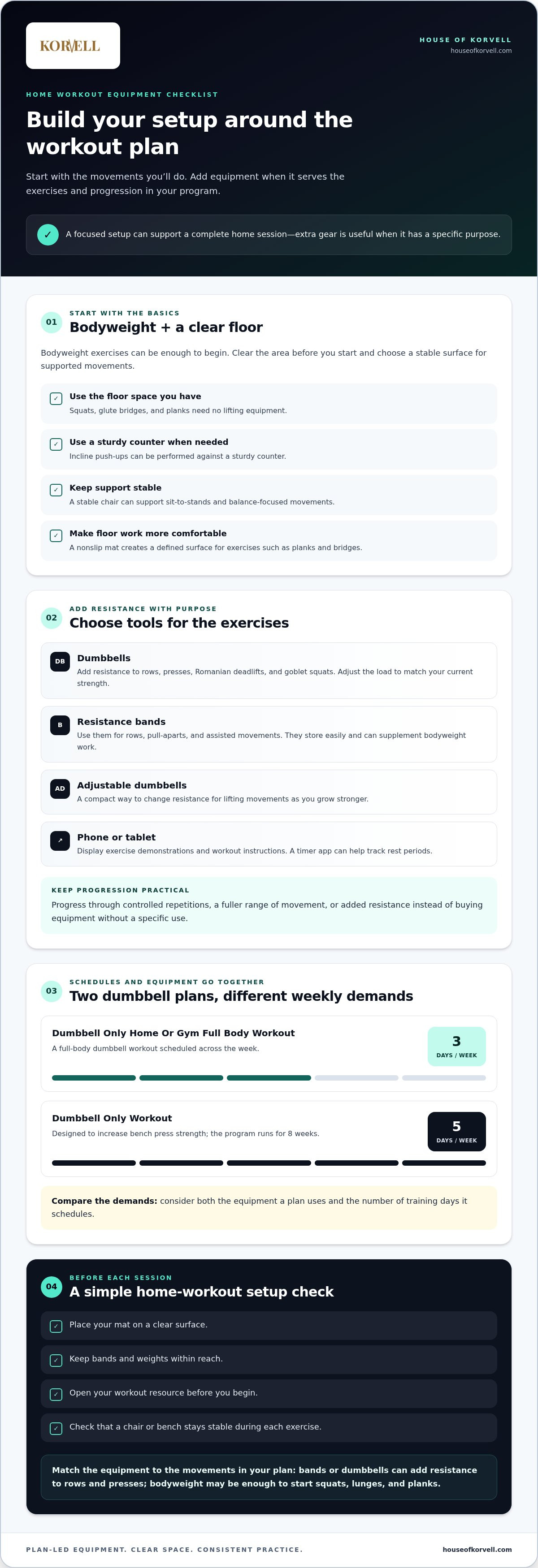
A home workout can start with bodyweight exercises and a clear patch of floor. Squats, incline push-ups against a sturdy counter, glute bridges, and planks need no lifting equipment. A nonslip mat can make floor exercises more comfortable, while a stable chair can support sit-to-stands and balance-focused movements. Clear the area before you begin.
Dumbbells expand the range of resistance exercises. They can support rows, presses, Romanian deadlifts, and goblet squats, with load adjusted to match your current strength. The “Dumbbell Only Home Or Gym Full Body Workout” is scheduled for 3 days per week. The “Dumbbell Only Workout” designed to increase bench press strength is an 8-week program scheduled for 5 days per week. Their schedules illustrate why equipment and weekly training demands should be considered together.
- Resistance bands: Use them for rows, pull-aparts, and assisted movements; they store easily and supplement bodyweight work.
- Workout mat: Creates a defined surface for floor exercises such as planks and bridges.
- Adjustable dumbbells: Provide a compact way to change resistance for lifting movements as you grow stronger.
- Phone or tablet: Displays exercise demonstrations and workout instructions; a timer app helps track rest periods.
Choose equipment to match the exercises in your plan. Bands or dumbbells can add resistance to rows and presses. For squats, lunges, and planks, bodyweight may be enough to start. Progress through controlled repetitions, a fuller range of movement, or added resistance instead of buying equipment without a specific use.
Set up by placing your mat on a clear surface, keeping bands and weights within reach, and opening your workout resource before you begin. Make sure a chair or bench stays stable during each exercise. An organized space can support a complete home session; extra equipment is useful only when it serves the program’s movements and progression.
Program selection by fitness goal
Start by naming your goal: build muscle, improve cardio endurance, or move with greater control. A muscle-building plan should organize resistance exercises and progression. A functional fitness plan can combine strength, balance, and mobility through movements such as squats, carries, and step-ups. If you’re preparing for a sport, look for sessions that reflect its demands.
Online plans vary in coaching, equipment needs, and customization. A self-guided plan typically provides a set schedule and exercise instructions. Coaching adds feedback, while individualized programming can adapt exercise selection to your goals, equipment, and training history. Compare these features, not just the plan’s title.
Before you start, note your recent training experience, available equipment, weekly schedule, and the movements you can perform with control. A training log can track loads and completed sessions, while a phone calendar helps you set realistic training days. For example, frequent travelers may benefit from a plan with bodyweight alternatives and sessions suited to a hotel room.
- Muscle growth: A 10 Week Mass Building Program is designed to increase muscle mass over 10 weeks. Training each muscle group directly or indirectly 2-3 times weekly can be beneficial.
- General fitness: Select a balanced routine that includes resistance exercises, cardio, and mobility work, then fit its sessions around your regular commitments.
- Travel: Choose movements that need little equipment, such as split squats, push-ups, and controlled trunk exercises, so the plan remains usable away from home.
Your schedule is part of the program. Choose a plan that fits your lifestyle rather than demanding more training days than you can manage. Map sessions around work, travel, and recovery in a calendar. If your available days change, a flexible plan is more practical than forcing an advanced split into a beginner’s routine.
When you finish the program, review your training log, exercise control, and consistency against your original goal. This record can help you decide whether to repeat the structure, increase the challenge, or choose a different training program.
Online workout program prices and free trials
This market range spans different formats, from self-guided plans to broader digital memberships. It does not describe every coaching service. Before judging value, compare the training structure, exercise demonstrations, tracking tools, and access terms.
A free trial can help you understand how a program works before you commit. Use it to review a sample session, check that the exercises suit your fitness level, and see how progress is recorded. Read the terms carefully: note when paid access begins, how renewal works, and how to end the trial. A calendar reminder can help you decide before it closes.
Consider cost alongside fit. A muscle-building plan may focus on resistance training, while a conditioning plan may emphasize cardio sessions and timed intervals. A broader platform may combine training styles, but extra features add value only if you use them. Check that each plan’s session length, equipment needs, and weekly schedule suit your routine.
- Program page: Compare the listed workout structure, exercise guidance, and training focus.
- Trial terms: Record the renewal date and cancellation steps in a calendar.
- Workout log: Track completed sessions and changes in strength or endurance.
- Cost calculator: Compare the total commitment across the billing period, not just the introductory offer.
Nutrition and training are separate considerations. Review what a program covers, then assess whether its exercise plan supports your goal and fits your available time. A low-cost plan may suit someone comfortable training independently; direct coaching may be more useful if you want individual feedback. The key question is whether the structure belongs in your routine.
If a clear training framework matters more than browsing trial features, explore a structured training path suited to deliberate progress.
House of KORVELL: Men's Foundations
House of KORVELL offers Men's Foundations, a structured digital training program for men seeking a clear framework for physique development. It suits readers who have considered their schedule and equipment and want a defined training path instead of building sessions on their own.
For a more specific physique focus, V-Taper Foundations offers another training direction. Women's Foundations and Glute Protocol serve different training goals. Choose based on the area of development you want your program to prioritize.
Men's Foundations is self-guided. If you want individualized support, House of KORVELL also offers Virtual Personal Training and Personal Programming. Choose the format based on how much direction you want in your routine.
Explore House of KORVELL at houseofkorvell.com to review the training options.
Set Your Training Direction
Choose a structure you can follow consistently. Decide whether you prefer independent training or individualized guidance, then build your routine around that choice. An online workout program for men is most useful when its format fits your real schedule and the kind of progress you want to pursue.
House of KORVELL offers Men's Foundations, Women's Foundations, and V-Taper Foundations, each with a distinct direction for physique development. Consider which focus matches your priorities, then review the program details before choosing a path.
If you’re ready to move from comparing options to choosing a structured approach, contact House of KORVELL. A deliberate start gives your training a clear direction. Build on it session by session, with patience and purpose.
Frequently Asked Questions
How many days a week should I work out?
Beginners can start with 2-4 workouts per week, using full-body or upper/lower sessions. Two weekly resistance-training sessions are a practical baseline; the U.S. Department of Health and Human Services recommends strength training major muscle groups twice weekly. Choose days you can protect consistently, then arrange demanding sessions to allow recovery between them.
What is the best workout schedule to build muscle?
A four-day upper/lower split is a common structure for building muscle, while three weekly full-body sessions can suit tighter schedules. Training each muscle group directly or indirectly 2-3 times weekly can be beneficial. Choose a pattern that fits your available days, then log exercises and loads to assess progression before changing routines.
What are effective online training options for men in 2026?
The right fit depends on your training experience, equipment, goals, and preference for coaching. Compare the instruction, schedule flexibility, and level of feedback or personalization. For physique-focused digital training, House of KORVELL offers Men's Foundations and V-Taper Foundations. Choose an option that meets your needs and gives you a structure you can follow consistently.
How do digital workout plans work?
An online workout program for men typically provides a digital schedule with exercises, instructions, and session details for home or gym training. Some plans are self-guided; others include direct coaching or individualized programming. Before you start, review movement demonstrations, note the equipment needed, and choose a level that lets you perform each exercise with control.
How much do online training plans cost?
The cost of an online workout program for men varies by format and support. A self-guided plan differs from individualized coaching in customization, feedback, and scope. For tailored services, the price depends on the case and is provided after a quote request; factors include coaching access, personalization, and training structure. Review trial terms and billing frequency before committing.
Which online programs offer strength, muscle-building, or fat-loss plans?
For strength and physique development, House of KORVELL offers Men's Foundations, V-Taper Foundations, and Personal Programming. Personal Programming can tailor a workout regimen to an individual’s schedule, equipment, and training objectives. For fat-loss goals, assess whether a plan’s exercise structure aligns with your priorities. Treat workout programming and nutrition planning as separate needs when comparing options.